Timeline · 1832 — 2026
From Cawnpore to the present day.
54 moments across four strands — Roberts's own life, the medicine and science of sight, the institutions that cared for those losing it, and the monocular men and women who led, flew, performed and governed.
Victorian
1832 — 1901
1832
Lord Roberts
Born at Cawnpore
Frederick Sleigh Roberts is born in India on 30 September 1832, son of General Sir Abraham Roberts.[8]
c. 1830s
Lord Roberts
“Brain fever” and the right eye
As a young child in India he nearly dies of an illness the family called “brain fever.” He survives, but loses the sight of his right eye. The left eye carries him for the rest of his life.[1, 2, 3]
1838
Society, Care & Rights
Teaching the blind to read
Thomas Lucas founds the London Society for Teaching the Blind to Read — the earliest predecessor of today’s Royal Society for Blind Children.[13]
1847
Lord Roberts
Passed fit at Addiscombe
Surgeons examining him for the East India Company’s military seminary certify his sight and hearing “perfect” — most likely a judgement on the function of his remaining eye.[2]
1851
Medicine & Science
The ophthalmoscope
Hermann von Helmholtz describes an instrument that lets a physician look into the living eye and see the retina for the first time — a diagnostic turning point.[14]
1858
Lord Roberts
The Victoria Cross
For gallantry at Khudaganj on 2 January 1858, during the Indian Mutiny, the young subaltern is awarded the Victoria Cross.[5, 8]
1862
Medicine & Science
Snellen’s letters
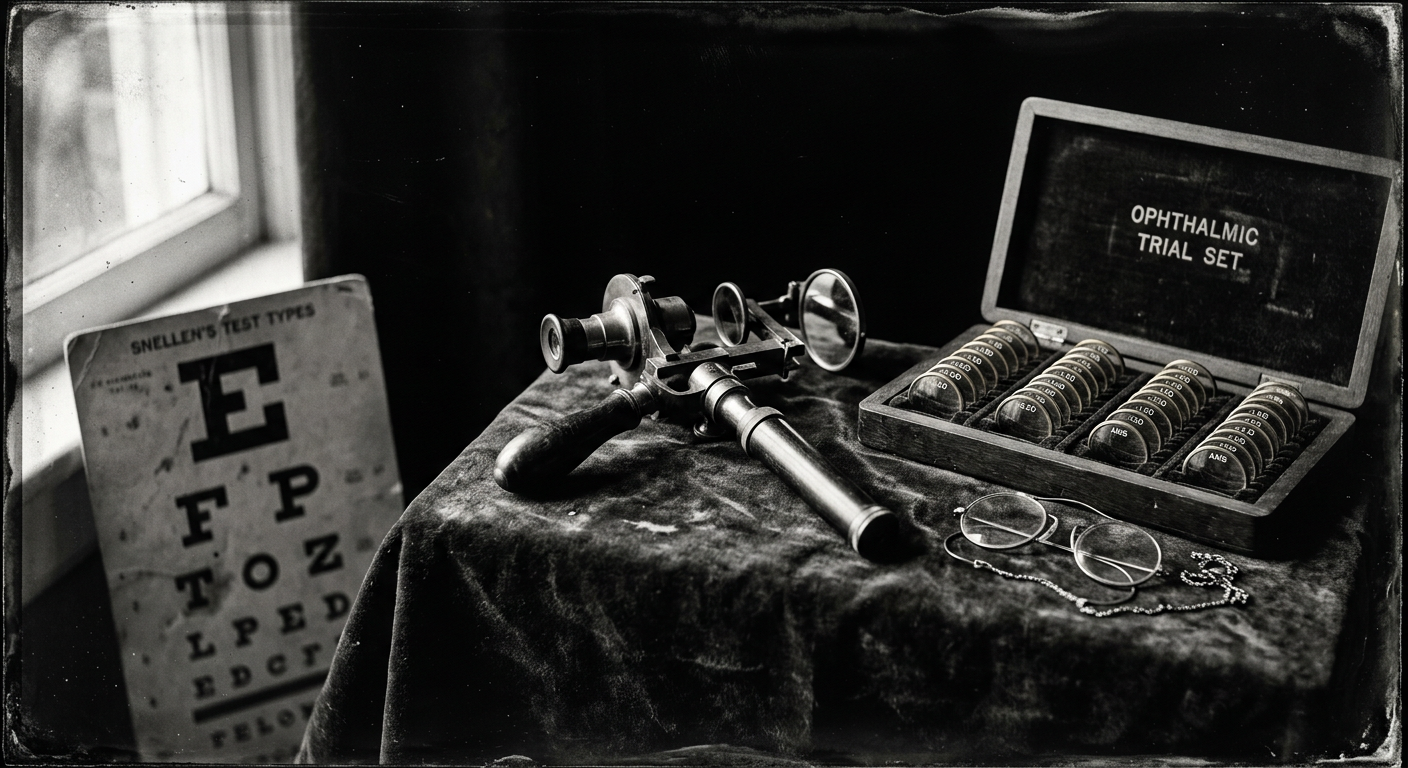
The Dutch ophthalmologist Herman Snellen publishes his test types — the eye chart still found in surgeries across the world.
1868
Society, Care & Rights
Embossed literature
On 16 October Dr Thomas Rhodes Armitage founds the British and Foreign Society for Improving the Embossed Literature of the Blind — the body that becomes RNIB. Access to reading is its first cause.[10]
1870
Society, Care & Rights
The Education Act
A national framework for elementary schooling in England and Wales. Separate blind institutions continue to expand, raising lasting questions of segregation, literacy and opportunity.[9]
1880
Lord Roberts
Kabul to Kandahar
Roberts leads some 10,000 troops roughly 300 miles in about three weeks to relieve Kandahar — a march planned, read and led with one working eye.[7, 8]
1880
Medicine & Science
A society for the eye
William Bowman helps found the Ophthalmological Society of the United Kingdom — a predecessor of today’s Royal College of Ophthalmologists.[32]
1884
Medicine & Science
Painless eye surgery
Carl Koller demonstrates cocaine as a local anaesthetic on the eye, transforming ophthalmic operations.
1885
Lord Roberts
Commander-in-Chief, India
He takes supreme command of the Army in India, serving until 1893.[8]
1888
Medicine & Science
The first contact lens
Adolf Fick describes a blown-glass lens worn directly on the eye.
1897
Lord Roberts
Forty-One Years in India
His memoir is published and becomes a bestseller. He writes little of his eye; the work speaks for itself.[7]
1900
Lord Roberts
South Africa
Appointed to command in the Second Boer War, he relieves Kimberley and enters Pretoria in June 1900.[8]
Edwardian
1901 — 1914
1901
Lord Roberts
Earl Roberts, KG
Created an Earl and appointed the last Commander-in-Chief of the Forces, serving until the post is abolished in 1904.[8]
1905
Medicine & Science
A cornea given
In Olomouc, Eduard Zirm performs the first successful full-thickness corneal transplant, restoring sight to a labourer blinded by lime.[34]
1911
Medicine & Science
The slit lamp
Allvar Gullstrand demonstrates the slit lamp and receives the Nobel Prize for his work on the optics of the eye. It remains the foundation of detailed anterior-eye examination.[33]
1913
Monocular Icons
Theodore Roosevelt
In his Autobiography the former President describes the persistently dim sight in his left eye after a boxing injury in the White House — his own account, not a later summary.[17]
1914
Lord Roberts
St Omer
Aged 82, Roberts travels to the Western Front to visit Indian troops. He dies at St Omer on 14 November 1914 and is buried in St Paul’s Cathedral.[8]
1914
Lord Roberts
The family account
Violet Brooke-Hunt’s biography records the childhood illness and the loss of the right eye — the earliest direct source located.[1]
War & Remembrance
1914 — 1945
1914
Monocular Icons
Adrian Carton de Wiart
In the same month Roberts dies, Carton de Wiart loses his left eye in Somaliland. He wins the VC in 1916 and serves through two world wars behind a black patch.
1915
Monocular Icons
Archibald Wavell
Wavell loses his left eye at the Second Battle of Ypres. Like Roberts, he becomes a Field Marshal and holds high office in India, as Viceroy from 1943.
1915
Society, Care & Rights
St Dunstan’s
Sir Arthur Pearson, himself losing his sight, founds the Blinded Soldiers and Sailors Care Committee. Known as St Dunstan’s after its first home, it is today Blind Veterans UK.[12]
1920
Society, Care & Rights
Blind Persons Act
A landmark UK statute on the welfare and employment of blind people.[25]
1931
Society, Care & Rights
The first guide dogs
In October the first four British guide dog partnerships qualify; the Guide Dogs for the Blind Association follows in 1934. One mobility choice among several — never a substitute for accessible streets.[11]
1933
Monocular Icons
Wiley Post
Having lost his left eye in an oilfield accident, Post becomes the first person to fly solo around the world.
1941
Monocular Icons
Moshe Dayan
Dayan loses his left eye in Syria. His eyepatch becomes one of the most recognisable silhouettes of the century.
Post-war
1945 — 1990
1948
Society, Care & Rights
The NHS
Eye care becomes free at the point of use. Access, outcomes and rehabilitation nevertheless remain uneven.[9]
1949
Medicine & Science
The intraocular lens
At St Thomas’ Hospital, Harold Ridley implants the first artificial lens — inspired by RAF pilots whose eyes tolerated Perspex splinters from shattered canopies.[15, 35]
1954
Monocular Icons
Sammy Davis Jr.
Davis loses his left eye in a car accident and goes on to decades of performance on stage and screen.
1967
Medicine & Science
Phacoemulsification
Charles Kelman introduces ultrasonic cataract removal. Adoption takes decades, but it later transforms cataract surgery worldwide.[32]
1968
Monocular Icons
Peter Falk
His right eye removed at the age of three, Falk first plays Lieutenant Columbo — a detective celebrated for noticing what others miss.
1970
Society, Care & Rights
Chronically Sick and Disabled Persons Act
Low-vision aids, social services and disability activism expand. The 1983 Commons debate in which Roberts is mentioned concerns this very Act.[4, 9]
1972
Monocular Icons
Gordon Banks
England’s 1966 goalkeeper loses the sight of his right eye in a car crash. In 1977 he returns to play in America and is named the league’s goalkeeper of the year.
1983
Lord Roberts
Hansard, 18 November
In the Commons, Robert Rhodes James says Roberts and Wavell were blind in one eye “from birth.” The record documents the claim, not the fact — Wavell, at least, lost his eye at Ypres.[4]
Modern
1990 — 2026
1990
Medicine & Science
LASIK
Ioannis Pallikaris performs the first laser in-situ keratomileusis, opening the era of refractive laser surgery.
1991
Medicine & Science
Optical coherence tomography
Huang, Swanson, Fujimoto and colleagues publish the first OCT paper. Non-invasive cross-sections of the retina become central to diagnosing and monitoring eye disease.[36]
1995
Society, Care & Rights
Disability Discrimination Act
Discrimination in public life and employment becomes a matter of rights and duties, not charity.[26]
2001
Society, Care & Rights
Royal National Institute of Blind People
RNIB adopts its present name — one that explicitly includes people who are partially sighted.[10]
2006
Medicine & Science
Anti-VEGF treatment
Injections such as ranibizumab are approved for wet macular degeneration — for the first time, sight loss in many patients can be halted. NICE issues UK guidance in 2008.[37, 38]
2006
Society, Care & Rights
UN Convention on the Rights of Persons with Disabilities
Accessibility, personal mobility and access to information are framed as human rights. The Convention enters into force in 2008.[23]
2007
Monocular Icons
Gordon Brown
A schoolboy rugby injury damaged his left eye; later problems threatened the right and needed treatment. He becomes Prime Minister — a modern case far more complex than simple one-eye blindness.[18]
2010
Society, Care & Rights
Equality Act
UK discrimination law is consolidated, with a duty to make reasonable adjustments. A registration card is not the sole test of protection.[24]
2012
2017
Medicine & Science
Gene therapy for the retina
Luxturna becomes the first approved gene therapy for an inherited retinal disease — a major milestone, but narrowly indicated, not a general restoration of sight.[39]
2018
Medicine & Science
Moorfields and machine sight
Moorfields Eye Hospital and DeepMind show an AI system can read retinal scans and recommend referrals with expert-level accuracy.
2019
Society, Care & Rights
World Report on Vision
The WHO’s first global report recognises that people with untreatable severe sight impairment can live independent lives where rehabilitation is available.[16]
2019
Monocular Icons
Dan Crenshaw
A former Navy SEAL who lost his right eye in Afghanistan in 2012 takes his seat in the US Congress.
2020s
Medicine & Science
Phones that describe
Screen readers, text recognition and AI image description become portable. Useful — but outputs can be wrong, and cost, privacy and digital exclusion still decide who benefits.[9]
2025
Medicine & Science
Reading again
Trial results for the PRIMA subretinal implant report that trial participants with geographic atrophy were able to read letters, numbers or words using the system. This is not a general restoration of sight.
2026
Medicine & Science
Integrated vision rehabilitation
WHO publishes a planning guide for building vision rehabilitation into health and eye-care systems. When sight cannot be restored, rehabilitation is still essential care.[41]
2026
Society, Care & Rights
Monocular begins
Two Lord Roberts Group reports of 2 October 2026 consolidate the evidence on Roberts’s eyesight and lay a research foundation connecting archive, clinic, rights and lived experience.[9]